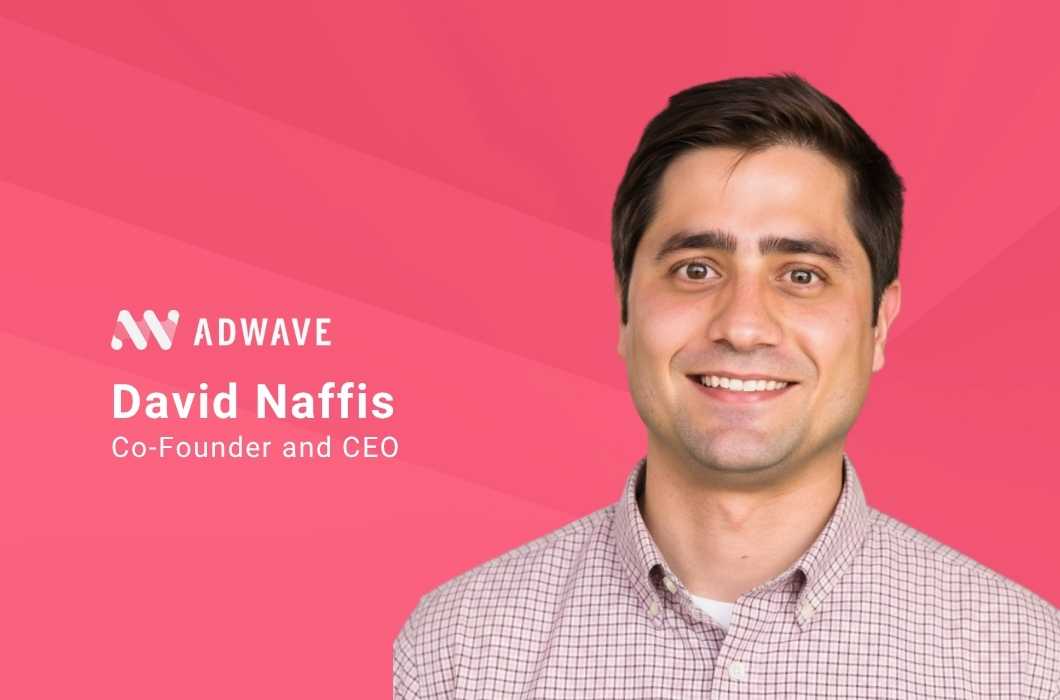
David Naffis is the Co-Founder and CEO of Adwave, a CTV advertising platform built for small businesses. Adwave makes it possible to create professional commercials and run targeted TV campaigns without agencies, lengthy contracts, or large budgets.
1. Self-serve platforms reshaped search, social, and display advertising over the past fifteen years. Why has broadcast-quality TV been the last channel to reach that inflection point, and what combination of factors finally changed that?
For most of the past 50+ years, TV didn’t lag because of a lack of demand. It lagged because of structural friction. Broadcast-quality TV was historically locked behind expensive creative production, manual buying processes, and a near-total absence of performance visibility.
What changed isn’t one thing. It’s a convergence. Streaming made inventory biddable, targetable, and programmatically accessible. Measurement finally caught up, giving advertisers the ability to tie exposure to site visits, conversions, and lift. AI unlocked creative production, making high-quality video fast and affordable. And behaviorally, audiences moved to streaming, which forced advertisers to follow, bringing with them the speed, control, and transparency expectations they had developed buying on social.
For the first time in TV’s history, inventory, measurement, and creative are all accessible and programmable at once.
2. CTV ad inventory has expanded significantly as streaming continues to displace linear TV. What does that structural inventory shift actually mean for small and mid-market advertisers who were priced out of television for decades?
It means real, meaningful access for a class of advertisers that TV largely ignored. Buying went from limited slots and gatekeepers to abundant, flexible inventory. Large upfront commitments gave way to adaptable budgets. Broad national targeting gave way to precise audience segmentation.
The expansion of CTV inventory effectively turns TV into a testable, measurable performance channel, not just a brand play reserved for companies with eight-figure media budgets. Small and mid-market advertisers can now enter, iterate, and scale in ways that were simply not possible before.
3. Precision audience targeting has traditionally been cited as social media’s core advantage over television. How does connected TV targeting compare today, and where does the gap meaningfully still exist?
CTV has evolved from broad reach to highly targeted, data-driven advertising, but it’s best understood as precision at the household level rather than the individual level. Social still leads on individual-level targeting, and that distinction matters for certain campaign objectives.
For most advertisers, though, that gap is a tradeoff rather than a blocker. CTV offers premium, lean-back environments with strong targeting and high brand recall. Social offers granular precision and speed. The strongest campaigns leverage both, using CTV and social in combination, each doing what it does best.
4. Agency relationships have historically been the gateway to television advertising. As self-serve CTV access expands, what role do you see agencies playing going forward, and does that role need to fundamentally change?
Agencies are going to need to evolve. The role shifts from gatekeeper to strategic partner, focused less on access and execution and more on driving outcomes. For large national brands, agencies will remain essential. But agencies have largely failed to serve small businesses at scale, and small businesses haven’t historically been accustomed to working with them.
That’s where the structural gap opens up. AI-powered platforms like Adwave can reach and service smaller advertisers quickly and at scale, something hands-on agencies aren’t built to do across a large volume of accounts. Inertia will keep enterprise brands in agency relationships, but the long tail of advertisers has a genuine alternative now.
5. Does TV now belong in a performance marketer’s toolkit, or does it remain primarily a brand-building channel with different success metrics?
It’s not an either/or anymore. CTV is a performance channel with brand-level strengths, a top and mid-funnel driver that creates measurable demand with downstream impact on conversions. The right approach is to integrate it with search and social to capture the demand it generates. TV has evolved from a pure brand play into a measurable, performance-driving channel, but its real power is in how it amplifies everything else in the marketing mix.
6. Most small business owners think about advertising in terms of immediate lead generation. How do you approach helping them balance short-term response metrics against the longer-term brand recall that TV is built to deliver?
That instinct is fair. Most small businesses default to “what did I get today?” But if you only optimize for immediate leads, you cap your actual growth potential.
TV builds measurable upstream signals: site visits, branded search lift, conversion rates across other channels. People aren’t buying things through their TV. Its role is to create familiarity so more people convert later through search, social, and direct. When more people are searching your brand name, clicking your paid ads, and converting after CTV exposure, that is performance. It just shows up across the full funnel rather than in last-click attribution.
7. How do you approach attribution in a streaming environment, and which methods have proven most effective?
Attribution in CTV isn’t about finding a single source of truth. It’s about building a clear, directional view of impact using multiple signals. Site visits, conversions, and branded search lift following exposure are among the most reliable early indicators. Measuring how CTV improves performance across search, social, and direct traffic often tells a clearer story than trying to force a deterministic attribution model onto a medium that doesn’t support one.
CTV attribution will never be as clean as click-based channels, but it can be highly indicative and actionable when you’re looking at the right signals.
8. With four times higher consumer trust than social media and 60% higher brand recall than digital display, does TV’s measurability gap still justify keeping it out of performance marketing plans?
Excluding TV today isn’t a measured decision. It’s a missed opportunity. The smarter approach is to treat CTV as a measurable performance driver that amplifies the efficiency of the rest of the marketing mix, rather than a siloed brand channel sitting outside the attribution model.
9. Looking ahead, how do you see the convergence of AI-generated creative, self-serve distribution, and CTV inventory growth reshaping the broader advertising landscape, and which types of businesses stand to benefit most?
The convergence of AI creative, self-serve access, and growing inventory is democratizing TV advertising in a meaningful way. High-quality ads can now be created quickly, launched without agency infrastructure, and targeted precisely at scale. Performance measurement allows businesses to test, iterate, and optimize CTV campaigns the same way they do in digital, which changes the risk calculus entirely for smaller advertisers.
The businesses that stand to benefit most are local and niche brands, DTC companies, and performance-focused advertisers who were previously priced out of TV entirely. Anyone who couldn’t afford traditional broadcast can now reach the right audience efficiently and at a budget that makes sense for their business.
10. Where do you think the quality of AI-generated creative will stand in 2026, and how do you address concerns about output quality?
AI-generated creative is already at a point where it can rival traditional production for most advertising use cases, and that gap will continue to close. Advances in generative video, voice, and graphics are making broadcast-ready creative fast and cost-effective to produce, which removes what has historically been the biggest barrier for small and mid-market advertisers.
The quality concerns I hear most often stem from process problems, not capability limitations. Poor AI output usually comes from generic prompts, weak strategy, or no iteration. When the input is strong, a clear brief, a well-defined audience, a specific message, the output reflects that. That’s the design philosophy behind Adwave: high-quality output requires high-quality input, and the ability to generate and test multiple variants quickly means an imperfect first version is just the starting point.
Author bio: David Naffis is the founder and CEO of Adwave. A serial ad tech entrepreneur, David previously co-founded VideoByte (acquired by Kargo, 2023) and Remixd (sold to Global UK/DAX US). In 2014, he served as a Presidential Innovation Fellow applying AI to National Archives documents. He founded Adwave to bring TV’s credibility advantage to Main Street businesses that couldn’t previously afford it.