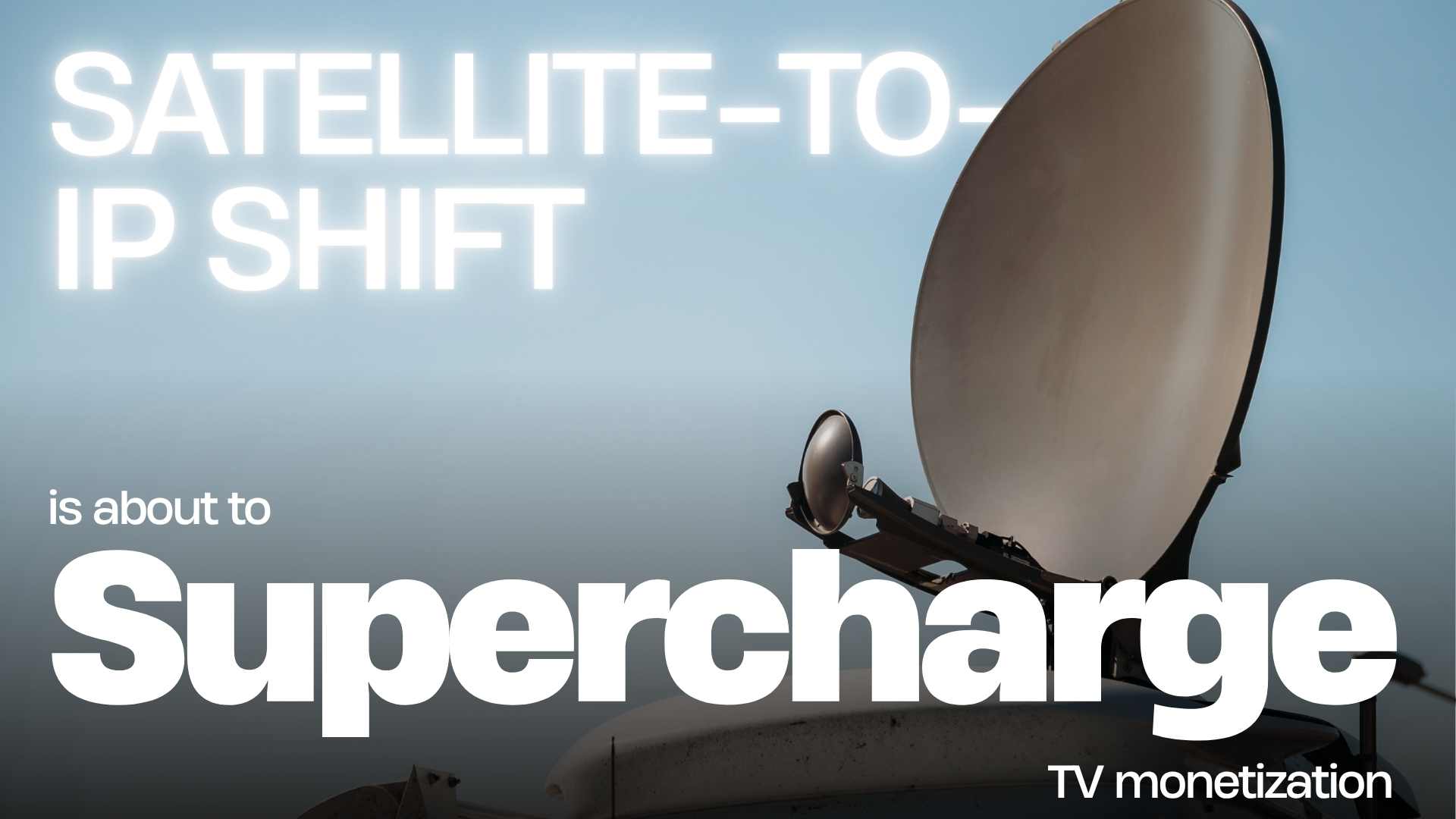
Broadcasters have long relied on satellite as a primary content distribution mechanism. But technology evolution and regulatory changes mean that infrastructure is in decline. As the industry prepares for another reduction in spectrum capacity by July 2027 with the FCC’s Upper C-band auction, discussions naturally center on continuity, reliability and managed replacement strategies. That should absolutely be the priority. Content owners need confidence that their most valuable channels and live events will continue to reach audiences without disruption.
But there is another story emerging alongside the transition.
The shift from satellite to managed IP networks represents one of the most significant monetization opportunities the television industry has seen in decades. Beyond replacing distribution infrastructure, IP creates the foundation for linear television to adopt many of the advertising capabilities that have transformed digital and connected TV.
For years, satellite distribution defined the limits of what was possible: a single video feed for the entire distribution footprint, with a lot of technical constraints on versioning for advertising inventory. Regionalized ads (“sectionals”) means a second feed. That model helped build modern television, but it also constrained how content owners packaged, sold and optimized advertising. As the industry moves toward IP-first distribution, those constraints are moving aside.
From world feed to flexible monetization
Satellite distribution was designed for footprint scale at low cost rather than customization. A single national feed could reach thousands of destinations simultaneously, but every taker effectively received the same version of the content and usually the same advertising inventory. “Tiered” approach at signaling the inventory, although technically possible, was often too complex.
In many cases, localized advertising opportunities have been managed downstream by distributors, MVPDs or platform operators. While effective, that approach limits how much control broadcasters and rights holders have over the final advertising experience.
IP changes that dynamic.
Instead of creating one version of a channel, content owners can increasingly create multiple tailored versions simultaneously, targeting different regions, audiences, platforms and commercial partners without multiplying operational complexity – and most importantly, distribution costs. What once required separate infrastructure and significant capital investment can increasingly be achieved through software-driven workflows operating across purpose-built IP environments.
This allows content owners to move control upstream. Market-specific advertising, graphics, sponsorship elements and promotional messaging can be embedded into feeds before they reach the endpoint. Inventory becomes more controllable, more customizable and ultimately, more valuable.
Over time, this could enable a fundamentally different commercial model – one where broadcasters and rights holders have far greater influence over how audiences are segmented, targeted and monetized across both linear and digital environments.
Bringing OTT-style ad flexibility to linear TV
Audiences no longer distinguish between linear and streaming experiences in the way the industry once did. The definitions of what ‘TV’ really means today are becoming more fluid. Regardless of viewing platform or device, advertisers want flexibility, relevance and measurable outcomes.
This is where IP distribution becomes particularly powerful. By enabling multiple feed variants and richer metadata throughout the delivery chain, broadcasters can begin applying many of the same principles that power digital advertising to traditional linear environments.
A critical part of that evolution is ad signaling. Effective ad break signaling and metadata insertion at playout or master control make it possible to support seamless downstream ad insertion, personalization and regionalization. Universal ad signaling technologies, intelligent SCTE marker management and frame-accurate triggering are helping bridge the gap between traditional broadcast workflows and advanced advertising ecosystems.
As these capabilities mature, broadcasters gain greater control over how inventory is packaged and delivered. Advertisers gain opportunities to target audiences with greater precision. Rights holders gain new flexibility around sponsorship integrations, regional commercial strategies and platform-specific monetization.
The result is that linear inventory becomes easier to align with the audience-based buying models that have become standard across digital advertising. It’s also good news for innovators across the OTT/CTV ad tech ecosystem that have long faced implementation blockers due to the constraints of satellite.
The decisions made today will shape tomorrow’s ad market
The countdown to the next Upper C-band auction is forcing important infrastructure decisions. But the most forward-thinking media companies are looking beyond the mechanics of replacing satellite distribution.
The bigger opportunity lies in what IP makes possible once it becomes the primary distribution layer.
By the end of this decade, geostationary satellite transmission will still be part of the delivery mix. The broader direction of travel, however, is toward IP-based workflows that allow content to be customized, versioned and monetized with far greater flexibility than traditional distribution models allowed.
Organizations are moving early to secure their distribution future and tap into new advertising methodologies. They’re unlocking emerging ad models, deeper audience addressability and new revenue opportunities that become possible when linear television gains the flexibility of IP.
The industry’s immediate focus should be on ensuring a reliable transition. But the companies planning furthest ahead understand that the real prize is not simply replacing satellite distribution – it’s building a more valuable advertising ecosystem for the future.
About Dimitri Tarassenko:
Dimitri Tarassenko, LTN’s SVP of Product Management, has over 15 years of experience in the media software industry. He previously led software development at Crystal Computer Corporation and was a member of the SCTE Digital Program Insertion Workgroup, which developed the SCTE-35 and SCTE-104 standards that power today’s linear ad tech workflows.
AdTech Edge is a leading digital publication covering the latest developments in advertising technology, AI-driven marketing, programmatic advertising, retail media, connected TV (CTV), data privacy, media buying, and digital advertising innovation.